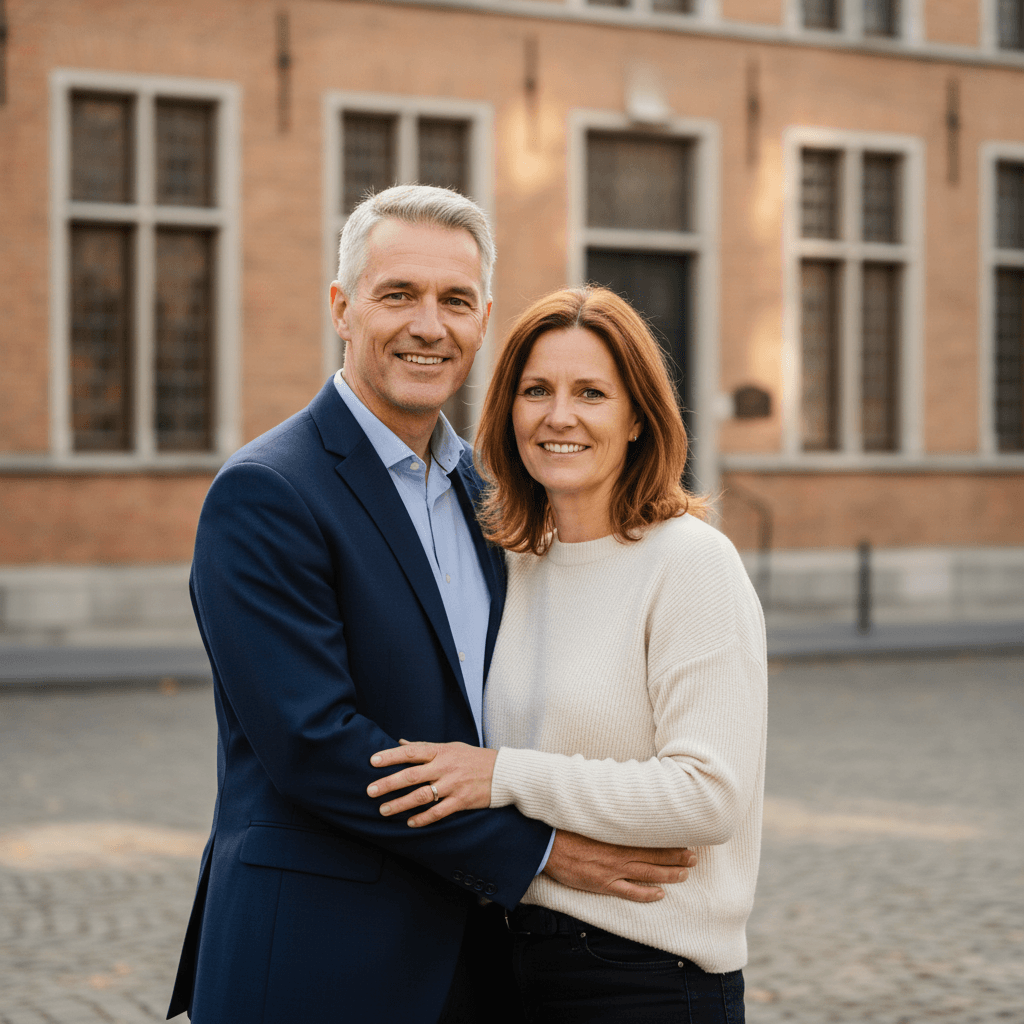
Peter & Anouk(44)
Maastricht → Hasselt
Peter had been working as an engineer at a company in Genk for eight years, and I was a nurse at Jessa Hospital in Hasselt. Every day we crossed the border — the traffic jams on the E314 were part of our lives. At some point we asked ourselves: why don't we just live in Belgium?
The financial calculation was complex. As cross-border commuters we already paid Belgian taxes through the double taxation treaty, but were fiscally resident in the Netherlands. After consulting a Belgian tax advisor, it turned out we would be better off net as Belgian residents, especially due to lower housing costs and deductions in the personal income tax.
Registration at the Hasselt municipality went smoothly. As EU citizens we only needed to apply for a registration certificate at the foreigners' desk. After a neighborhood check by the police — they come to verify you actually live at that address — we received our Belgian eID card. You need it everywhere: bank account, health insurance fund, even at the pharmacy.
Health insurance was the biggest change. In Belgium you choose a mutualiteit (health insurance fund) — we chose the Christelijke Mutualiteit (CM) in Limburg. The basic insurance covers a lot, but you pay upfront and then receive a reimbursement. That took getting used to: you pay for a doctor's visit in cash, then get 75% back. For medication there's a co-payment system.
Buying a house in Hasselt was surprisingly affordable compared to Maastricht. We found a terraced house with garden in Kuringen for \u20AC285,000 — in Maastricht this would cost at least \u20AC100,000 more. Registration duties in Flanders are 3% for your only own home, which is a major advantage over the 10.4% transfer tax in the Netherlands.
After two years, Hasselt feels like home. The city is charming, the Limburg mentality resembles Maastricht's, and we save significantly each month. My advice to cross-border commuters: get proper guidance from a tax advisor who knows both systems. The rules around cross-border work and the tax treaty are a maze, but it pays to navigate through them.
Highlights
- Registration duties only 3% in Flanders vs. 10.4% in the Netherlands
- Belgian eID needed for everything: bank, health fund, pharmacy
- Mutualiteit system: pay first, then 75% reimbursement
- Tax advisor who knows both tax systems is essential
Other stories
Fleur
Rotterdam → Antwerpen
As a marketer I found in Antwerp a vibrant city with lower rents and more character than Rotterdam. The Belgian bureaucracy took some getting used to.
Bas & Linda
Eindhoven → Gent
With two children aged 4 and 7 we moved to Gent. Flemish education is excellent, the Groeipakket generous, and the city perfect for families.

Marcel
Amsterdam → Brussel
Setting up a BV in the Netherlands took three weeks. In Belgium it became a BVBA — now BV — and cost me two months, a notary and lots of patience. But the Brussels market is worth it.